Introduction
Search has changed.
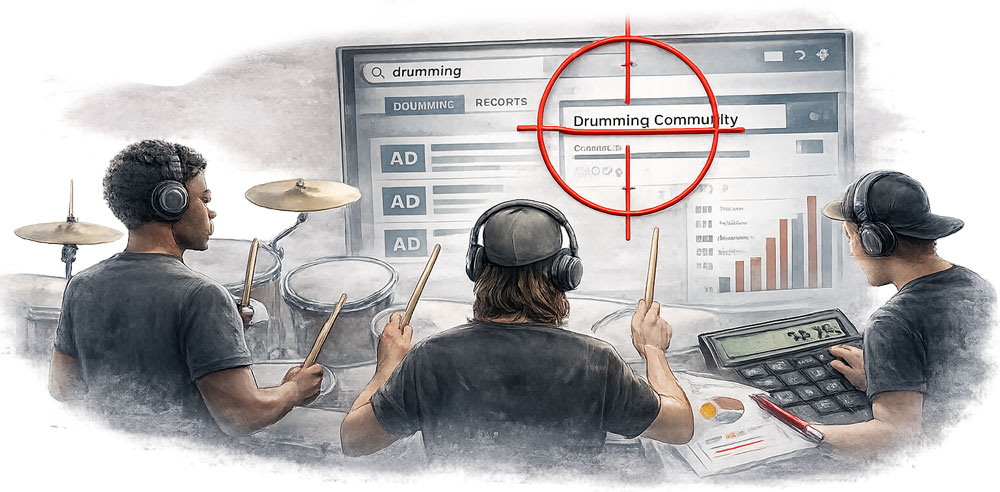
What used to be a simple way to find websites has turned into something very different. Instead of showing you a range of sites to explore, modern search engines now try to answer the question for you before you ever leave the page.

That might sound efficient, but it comes with a cost. And of course, it’s great for google.
Suffice to say, smaller websites are getting buried.
If your site isn’t backed by high-authority domains, massive backlink profiles, or years of established trust signals, it struggles to appear at all. Even great content gets pushed down the results, hidden behind bigger brands and platforms that already dominate the space.
It’s no longer about who has the most useful content.
It’s about who already has the most authority.
That creates a closed loop.
The big sites stay visible.
The smaller sites stay invisible.
And unless you pay for ads or somehow break into that top tier, your work sits unseen.
The Groove Engine project exists to break that cycle.
The goal is simple:
Give drummers and musicians a way to be found based on what they actually create themselves — not who is linking to them.
A search experience where relevance matters again.
Where content is judged on its value.
And where smaller, independent sites finally have a fair shot at being seen.
What The Groove Engine Is
The Groove Engine is an independent search system built specifically for musicians.
It starts with drummers.
Not as a niche experiment, but as a focused and growing environment where search actually works for the people using it. Instead of trying to serve everyone, it’s designed to serve one group more effectively, then expand from there into bass players and other musicians over time.
This is not tied to the usual search ecosystem.
It doesn’t rely on the same ranking systems.
It doesn’t depend on authority signals from massive sites.
And it doesn’t prioritise brands over individuals.
It’s built to serve real websites. Created by real musicians.
If it’s useful and relevant, it has a place in The Groove engine.
- Teaching sites.
- Blogs.
- Tools.
- Services.
- Independent creators.
The aim is simple:
Create a search experience where musicians can actually find other musicians… without everything being filtered through the same handful of dominant platforms.
Why Traditional Search Failed You
Search didn’t break overnight. it developed. And as it developed, it drifted.
What used to be a way to discover websites has turned into something else entirely. A place where your site can, “maybe,” get discovered would be generous.
And of course, the most recent change came with the shift to AI answers. Provided by google.
Instead of sending users to your site, if you managed to get there, the search engine tries to answer the question itself. That means fewer clicks, fewer visitors, and less chance for your content to ever be seen.
Then further back came the dependence on backlinks.
Your site isn’t judged on what you create. It’s judged on who is linking to you. If high-ranking sites don’t point to you, you’re pushed down, no matter how good your content is.
On top of that, authority bias took over.
Established domains dominate results simply because they’ve been around longer or have built momentum. Having the biggest budget being a major advantage. New or smaller sites are treated as less important by default.
And then there’s pay-to-play visibility.
If you want to be seen, you’re expected to advertise. Organic reach shrinks while paid placements take over the most visible positions.
It all follows the same pattern.
- Platforms start out cheap.
- They promise exposure.
- People build on them.
Then prices go up.
Competition increases.
Visibility becomes something you have to buy.
That model doesn’t help independent creators.
It locks them out.
And that’s exactly what this project is designed to move away from.
Who This Is For
The Groove Engine is built for people who actually create something.
- Drumming websites with real content
- Musician blogs sharing ideas, lessons, or experiences
- Teaching platforms offering structured learning
- Tools and services that help musicians improve or work better
If your site serves a clear purpose and helps drummers or musicians in a real way, it fits.
It doesn’t matter if you’re new.
It doesn’t matter if you don’t have traffic yet.
What matters is that your site is real, focused, and useful.
Who Will Not Be Listed
Not everything gets in.
- Spam sites created just to capture traffic
- Pages stuffed with keywords but offering no real value
- Thin affiliate pages built only to push links
- Low-effort AI content with no originality or usefulness
- Inactive sites with little or no meaningful content
If the purpose of the site is to game the system, it won’t be listed.
If the content doesn’t help anyone, it doesn’t belong in The Groove Engine Index.
Simple as that.
But, don’t worry. If you are a legitimate website you’re certain to get in the groove engine search index.
But lets take a look how it differs from the corporate giants.
How Ranking Works
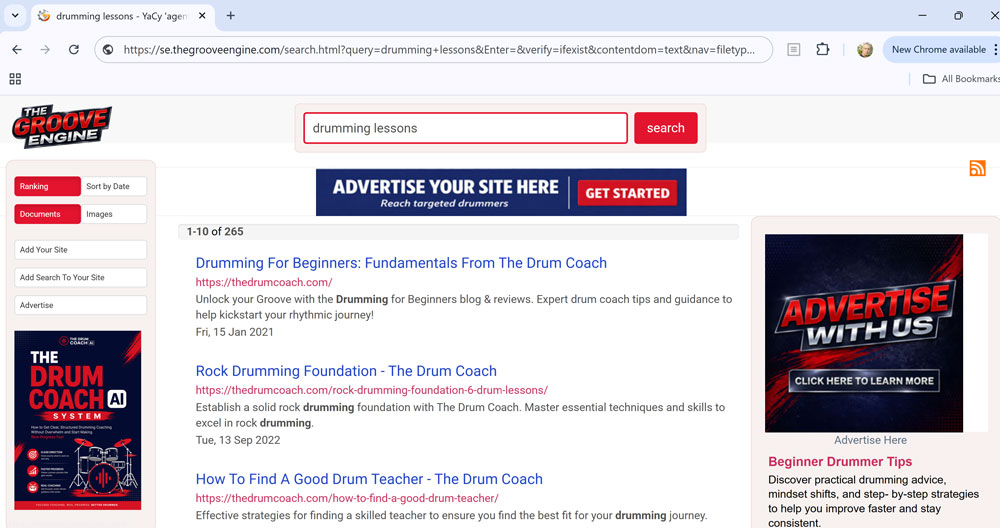
Ranking is based on what’s actually on your page. Just like a regular search engine…
- Your title matters
- Your main headings matter
- Your content matters
- Your structure matters
Specifically, the system looks at things like:
- Author information and relevance
- Your page description
- Your keywords (used properly, not abused)
- All visible text on the page
- Supporting language and related terms
- Your main headings (H1, H2)
- Your URL structure and file naming
- Your page paths and how your content is organised
In simple terms, it reads your page and decides what it’s about.
There’s no reliance on backlinks.
There’s no authority bias.
There’s no advantage for big brands.
If your page clearly matches what someone is searching for, it gets seen.
That’s how search used to work.
And that’s what The Groove Engine brings back.
How To Rank Properly
To get listed and before submitting your site. Start with clarity.
- Use clear, direct page titles that say exactly what the page is about. No clever wording. No guessing.
- Keep each page focused on one topic. Don’t try to cover everything at once. One page, one purpose.
- Make your content useful.
Answer the question. Solve the problem. Give the reader something they can actually use. - Write for real people.
Not algorithm hacks. No page tricks. No ranking manipulations.
If a drummer lands on your page and gets what they came for, you’re doing it right.
That’s the standard.
Now let’s take a look at the front end.
Tags and Search Behaviour
Search works best when you keep things natural.
Use real phrases that someone would actually type.
Think like a drummer searching for help, not like someone trying to trick a system.
Examples of good tag usage:
- Beginner drum beats
- How to improve timing
- Drum practice routine
- Snare tuning guide
- Best way to hold drumsticks
These are clear, direct, and match real intent.
Avoid:
- Keyword stuffing
- Repeating the same phrase over and over
- Trying to rank for everything on one page
- Unnatural wording that no one would search for
If it sounds forced, it most likely won’t work.
Understanding Search Behaviour
As we’ve seen, search is based on intent.
Someone is either:
- Looking to learn something
- Trying to fix a problem
- Searching for a specific topic
Your job is to match that intent clearly. Just as search engines have always required.
The closer your content matches the exact phrase and meaning, the better it performs.
Advanced Search (Optional)
For more control, The Groove Engine search can be refined using simple operators.
These let you narrow results quickly:
- inurl: find pages with a phrase in the URL
- inlink: find pages that link to a phrase
- filetype: filter by file type (pdf, html, etc)
- site: search within a specific website
- author: find content from a specific author
- tld: filter by domain type (com, org, etc)
Date filters:
- on: find content from a specific date
- from: to: search within a date range
Keyword filtering:
- keyword: search based on tagged keywords
Other filters:
- Use quotes “” to match exact phrases
- Use language filters to prioritise specific languages
Search Navigation
As a user searching, not only are you able to make use of the operator/filters just mentioned, but you can also:
Move through results quickly using simple controls.
Refine searches with more specific phrases.
Use filters to narrow results instead of broad searches.
Keep It Simple
Most people won’t need advanced filters.
If your content is clear, focused, and matches real search intent, it will show up for regular searches that are relevant.
… and of course, that’s the whole point.
Ethics and Standards
This only works if it stays clean.
No manipulation tactics.
No keyword mashups designed to trick rankings.
No spun content or recycled garbage dressed up as new.
If you’re trying to game it, you won’t last.
Content is expected to have a real purpose.
It should help someone.
Answer something clearly.
Provide actual value.
Not just exist to rank.
There’s one rule behind all of it:
If it’s useful, it stays.
If it’s not, it gets removed.
The whole point of all of this is relevance, so you wouldn’t want to show up at the top of a search result for someone looking to buy a drum kit when you were just selling a drumming course. what would be the point? Of course, there isn’t one.
So create your content, optimize and refine it based on title content and heading and you’ll most likely hit the top of relevant lists.
No Social Media Listings
No Facebook pages
No Instagram profiles
No YouTube channels
This is a website-first search engine system.
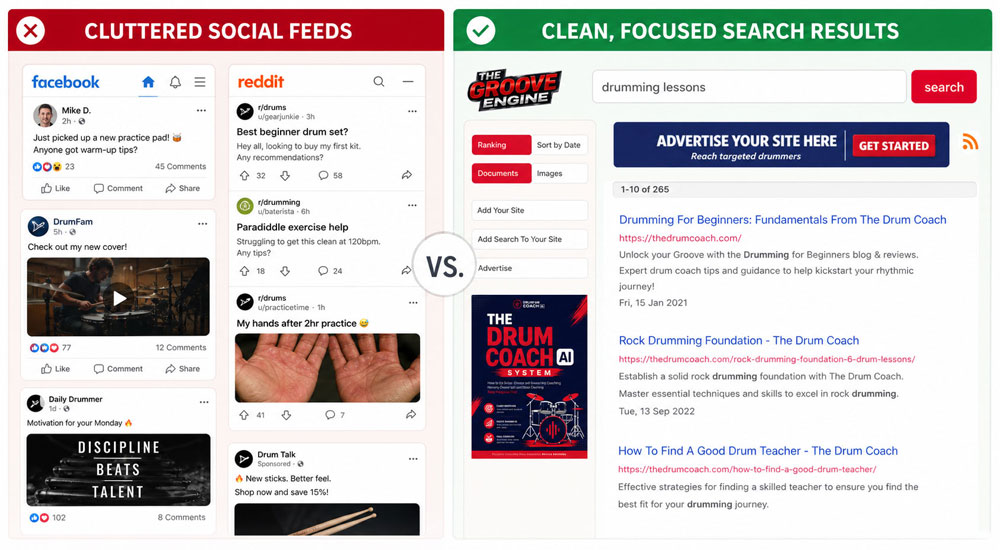
The goal is to take the internet back and give it back to musicians. Right now, everything gets buried inside platforms.
Reddit threads.
Facebook groups.
Endless social feeds.
Your content lives there… but you don’t own it. And most of it disappears as quickly as it shows up. If it shows up at all. The Groove Engine moves away from that. It puts the focus back on real websites. Places you control.
Content that lasts.
There is one exception: Drummery.
Because it’s built differently. It’s structured. It’s searchable. And it’s designed specifically for drummers. Not a generic social platform chasing attention from all angles.
If anything, The Groove Engine may push more musicians to build something of their own there… instead of relying on platforms that bury them.
Submit Your Site
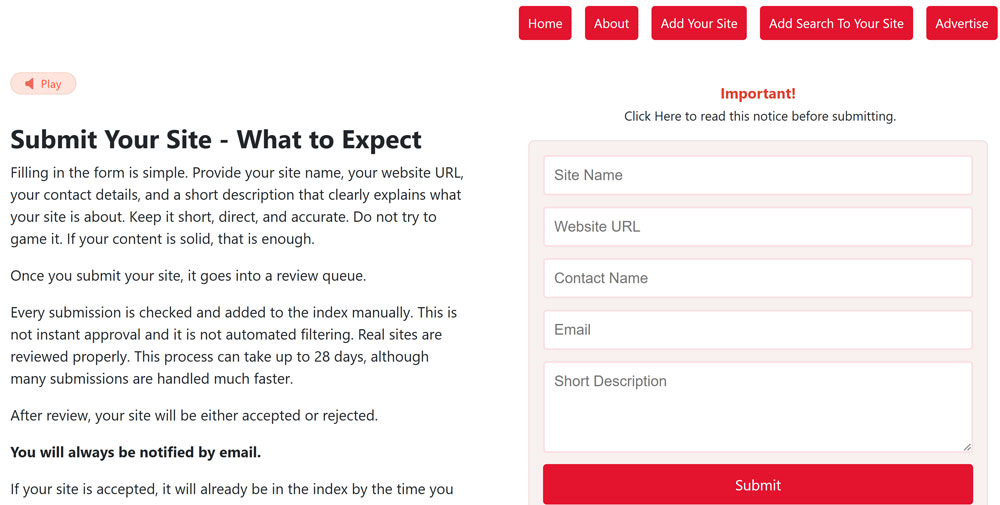
Submitting your site is straightforward. You provide your website URL along with a few basic details about what your site is and who it’s for. That’s it. There’s …
- No complicated forms.
- No authority checks.
- No paid placement options.
Once submitted, your site is reviewed to make sure it fits the fundamental standards required. Then, if it’s a real site with real content and a clear purpose, it gets included in the index.
What Happens After Submission
Your site is indexed and becomes searchable within the specified time. From that point on, visibility comes down to your content.
Pages that are clear, relevant, and useful will appear for the right searches. Pages that aren’t, won’t. There’s nothing else to “build up” in the background. No backlink chasing. No waiting for approval from other sites.
Just your content doing the work you designed it to do.
Add Search To Your Website
You can add a search box directly to your own website. This lets your visitors search drumming and musician-focused results without leaving your site. It keeps everything relevant to what they’re already interested in.
Of course if no one uses The Groove Engine to search for drumming and musician related content, then being listed is a waste of time. So, we ask everyone who gets listed to add a search box to your website. Then, over time, musicians will make using The Groove engine a part of their daily content searching habits.
Search Box Feature
A search box is simple to add to any page on your existing website. results will open on a new page showing results from within the engine index.
Your visitors stay in a musician-first search environment instead of being pushed back into general search engines.
You can add the search box to your site by visiting this page link.
Benefits to Site Owners
The search box keeps users on your site longer and improves engagement and usability of the engine.
It also positions your site as a resource hub, not just a single page or blog. especially if you have a specific page just for search.
Instead of sending people away to search elsewhere, you keep them inside a focused network built for musicians.
Of course, if someone searches from your site, and finds someone else’s site. That site benefits. But the same is true if someone searched from someone else website. This means whilst you help other musicians, they help you in return. Maybe not directly, but nevertheless, your site gets a chance of being seen from someone else’s site. This is really why relevancy should be your top priority when creating content.
Long-Term Vision
This all starts with drummers. That’s the foundation. A focused space where search works properly, content is relevant, and smaller creators can actually be found.
From there, it expands.
- Bass players
- Guitarists
- Other musicians
… and so on. Each added carefully, without losing the core principle.
The goal isn’t to become another general search engine. The goal is to build a network for drummers and other musicians. A musician-first search system where every category still feels focused, relevant, and usable. Not crowded, and not diluted.
Just a better way for musicians to find each other.
Closing
The Groove Engine exists for one reason. To give musicians a fair way to be found.
- Not based on who’s linking to you.
- Not based on how big your site is.
- Not based on how much you can spend.
Just on what you’ve actually created. If your site has value, it deserves to be seen.
That’s the standard.
If you’ve got a drumming or musician-focused website, take the next step.
Read the full guide within this post.
Submit your site.
Add the search box if it fits your setup.
Start being part of something that’s built for musicians, not platforms.
Now is the time… to get Into The Groove Engine!